A university timetable planner built around the constraints students actually plan their lives by: who’s teaching a section, how early the week starts, and how long each day runs. It surfaces the resulting schedules as a browsable weekly calendar.
I find the most stressful part of starting a new academic year to be selecting courses and building a schedule. The schedule builders most universities use are quite limited, only allowing simple things like adding courses and including or excluding sections. Most don’t let you include or exclude certain professors for certain courses, set a limit on the number of courses per term, set a maximum gap between classes, or apply the other constraints you’d typically want in order to see a list of schedules you’d actually choose from. That’s the problem Termtile tries to solve.
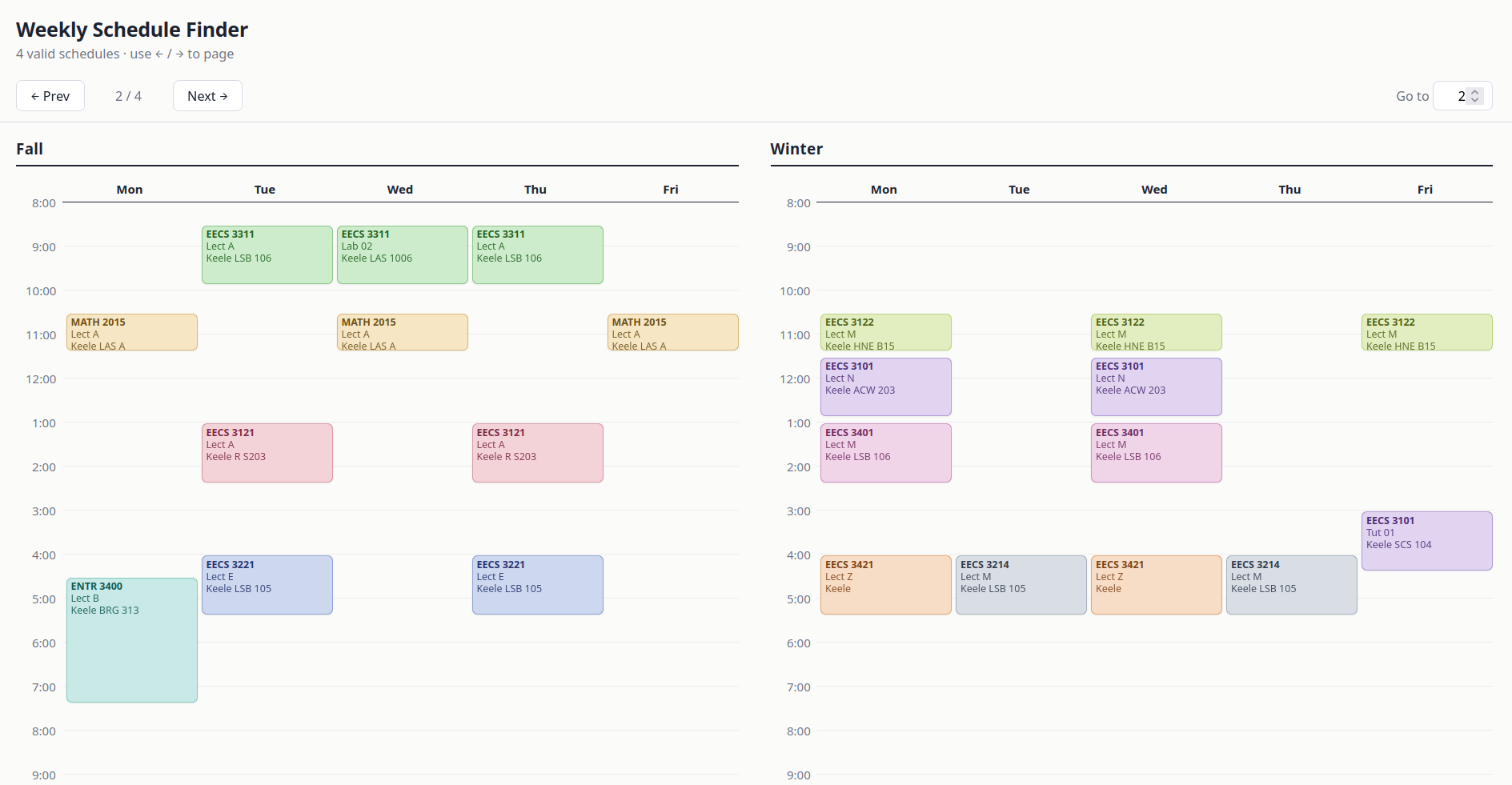
Termtile is still a work in progress. So far I’ve written the parser (in Python) and the constraint solver (in TypeScript). Below is a mockup:
What I’d do differently
I wrote the solver in Python first, got it working, and then realised I wanted the whole thing to run in the browser with no backend, which meant rewriting it in TypeScript. The rewrite wasn’t wasted exactly, since I understood the problem better the second time, but it was avoidable. I had decided how the solver would work before deciding how anyone would actually run it, and the deployment constraint was the thing that should have driven the language choice from the start. Now I try to settle where something has to run before I write it. The interface is also still a mockup: the solver produces correct schedules, but nobody except me can use it yet, which is the honest limit of the project as it stands.